Wednesday, April 10, 2013

Ice removal from greens

I am a couple weeks behind with posting this but as I suggested in my last post grass under ice is not a ideal situation. We removed snow from the greens in early March to facilitate ice melt but then more snow fell and temperatures remained cold.

On March 25th the forecast suggested sunshine and upper 30 temperatures so we decided it was time to clear the greens. We started with the snow blower but when it took 8 hours just to clear the 15th green due to the deep snow I tried the dump truck and plow. It did a great job clearing the greens, but getting to the green took some skilled driving and luck as the drifts were deep.

Our goal was to remove snow on Monday/Tuesday and allow the ice to melt quickly before cold temperatures returned.

Plow on 3 green. With the ice no damage was done to the grass.

15 Green freshly blown off. The snow was too deep to plow.
 
Green dye applied to the green on Wednesday March 27.
The dark color absorbs sunlight and speeds melting.
 
With the deep snow we used a sled, a hand sprayer and jugs of water
 to apply dye to the greens.


Thursday March 28 the green is almost bare. The temps were only in the 30's
but the sunshine did the trick.

After plowing vole runs could be seen in the ice on the greens. I have never seen this before on greens. After the ice melt there was no visible damage.

By Saturday March 30 only holes 12 and 16 had any ice remaining and we chopped that up by hand to speed melting.
 
The greens may have been fine no matter what we did but after the long winter removing the snow and ice was the best decision.


Saturday, March 9, 2013

Ice, Is it A Problem?

It is hard to believe a year ago we had the range open and the grass was green and we were 4 days from opening the golf course. Last March was the warmest March on record and actually on average was warmer than April. Unless we have a sudden heat wave that will not happen as the golf course is still covered in 1-3 feet of snow with deeper drifts. Yes that is feet!

Even this year it is hard to believe the golf course was clear of snow in early January with temperatures in the 50's. This was followed by rain and snow and rain and snow and snow and rain and more snow. I could go on but I think you get the picture.

The best winter for the grass you play golf on is mild like last year or cold and stays cold. Frozen, dormant and under snow is the best way for greens, tees and fairways to go through winter with no damage.

We do have some dreaded ice on the surface throughout the course but especially on greens and fairways. In the low pockets it formed during the January rains but most of the water drained away from that storm. The 1-1.5" layer of ice formed in mid February when rain on top of snow was followed by cold temperatures.

Ice can be a problem as we found out a few years ago when we had substantial damage from ice. But ice is not always a problem but just a natural part of winter. When ice kills grass it is usually in two main ways.

Suffocation - A solid clear ice over turf can kill poa annua in as few as 45 days through suffocation and bentgrass in 60 to 120 days depending on the level of dormancy. The greener the grass the quicker it dies under ice. Brown grass is good grass in winter!

Crown Hydration - Any damage we have in Fond du Lac is usually caused by crown hydration where the plant is green and full of moisture due to winter rains or melting snow followed by a sudden cold snap before the plant can get rid of the water in its cells. This actually causes the cells in the plant to burst and kills the plant.

This can also occur when the turf is covered by ice and the ice actually magnifies the suns rays causing a greenhouse effect. The grass starts to come out of dormancy and takes up water. At night the water under the ice freezes and the grass is weakened. If this happens day ofter day the grass will die. It is referred to as freeze thaw damage.

This year we have a layer of white ice across most of the golf course. So far it is nothing to worry about but a quick meltdown will help us get through spring without damage.

To speed up the process we started removing the snow off the greens last week so the ice would melt faster and this weekends rains would run off the putting surface without being held up by the snow. This late in the winter we would prefer the grass was exposed rather than covered in snow.

The greens I cleared this week had an average of 12" of snow but any swails where we need the water to run had 24 - 36" of snow that would have stopped water from running away and cause ponding and solid ice puddles as we go through the freeze thaw cycles.

Finding key drains allows water from melting snow or rain to reach the drains.
This one on hole 11 was under 2' of soft snow and 2' of hard packed snow that
would have stopped drainage.

Toro 3280 with Erskine Snowblower.
The heat doesn't work but it gets the job done.
 
The snow on the middle of 5 green is almost to the top of the blower.
 
 
Removing snow this deep is a slow process and often it takes a hour to get from one green to the next due to the ice under the snow. This week we cleared our problem greens 5, 7, 10, 16, 19, 21 and 24 where we no the snow would stop water from running off. The forecast yesterday was saying 1 to 1.5" of rain for tonight so time will tell what the golf course will look like tomorrow. That much rain should melt a lot of snow if we can keep temperatures above 40.

Think spring and we hope to see you on the links soon!

Winter Education

One of the highlights of being a golf course manager in the north is the offseason allows for more than equipment and building maintenance and that necessary evil called paperwork. It is a great time to tune up our minds and learn new ideas and hear about current research.

Every 5 years we need to brush up our knowledge on pesticide applications, products, safety and regulations as we study for our Pesticide Applicators Certificate. That can be a bit boring after the 2nd time but is a necessary item. On top of that we are lucky in Wisconsin to have strong organizations that offer outside education each year.

Starting the offseason is the Wisconsin Golf Turf Symposium a two day session entering its 47th year. The symposium is unique because it takes one topic and breaks it down for two days. This years topic was "Whats In Your Tank? and it covered the variety of items that can be applied to a golf courses to promote plant health. Herbicides, growth regulators, fertilizers, fungicides, insecticides, amino acids, wetting agents to name a few. New research focuses on using less products and how proper applications of select products with proper timing can reduce overall pesticide or fertilizer use with better results.

New technology in herbicides has developed products that can not only take crabgrass out of turf it can take bentgrass out of bluegrass or bluegrass out of bentgrass. The new buzz is a product called Poa Cure from Korea that so far has shown to take the dreaded poa annua out of bentgrass greens, tees and fairways successfully. Trials are still ongoing but this product shows promise to do so without damage to the bentgrass or reducing overall turf quality. It is expected to cost $2,500 per acre annually but may be worth it considering it will reduce other plant protectant inputs and water use while providing better playing conditions.

In January the Wisconsin Turfgrass Association hosted a Research Day when 11 researches at the University of Wisconsin Madison presented their latest research. It is valuable to see results locally rather than nationally because the soils and climate are similar to ours. The groundbreaking presentations were by professors and graduate students at the university.

In February the granddaddy of all trade show / educational conferences is hosted by the Golf Course Superintendents Association of America and the National Golf Course Owners Association. The show moves around but is always in the south to reduce weather concerns. This years show in San Diego was smaller but still large with 13,192 attendees and 517 vendors occupying 172,900 sq.ft. of trade show space. The trade show is a great opportunity to see vendors of every golf product imaginable from cash register systems to shovels and clubhouse design firms to  equipment manufactures. The real benefit of the show is the education and this year offered 89 free seminars taught by educators and researches and 105 seminars for an extra fee.

Some of the sessions I sat in on included:
  • The Benefits of Rolling Greens - Research is showing that rolling properly made sand profile putting greens doesn't just increase green speed and smoothness. Regular rolling is shown to reduce diseases and moss while increasing soil moisture holding capacity and good bacteria levels. Recommendations were to roll daily while mowing less than every day to balance plant health and green speed.
  • Women in Golf - The speakers taught different ways to not only attract women golfers but keep them as long time customers. Women control the time and finances in many households and have a major impact on the economy. It also focused on all beginning golf programs and the barriers to enjoying the game as a newcomer.
  • How to protect and promote our online brand - New "apps" are available to consolidate social media platforms while tracking what others say about the facility. Discussion also included how to increase website search capability.
  • New technology to monitor turf conditions especially during stressful weather - Soil probes, portable weather stations and infrared thermometers are common on golf courses to promote plant health and to determine when to syringe or lightly apply water during summer stress periods like we had last summer. A light pass of water can reduce surface temperatures of greens or fairways from 100+ to 80 and allow the plant to survive the day.
  • Advocacy In Action - This session discussed the challenges golf and the ag industry are having with the EPA and the work in progress to fight back and in some cases ask for help from congress to reduce those challenges from all powerful agencies.
Dr. Chris Williamson Entomologist at UW Madison discusses
Insect Research

The Wisconsin Golf Course Superintendents Associations host their meeting in early March with the State Chapter in Fond du Lac with a half of a day of education and the association business in the afternoon while the Northern Chapter in Wausau with a full day of education on various topics. This year the state chapter focused on leasing vs buying capital equipment and the use of water or how to use less water. The northern chapter focused on how to prevent and recover from winter damage along with new plant health research.

And finally this year one of our vendors Reinders Brothers in Menomomonee Falls has a trade show / education day in Mid March at the Waukesha County Expo. Reinders is our vendor for Toro, Foley, True Turf, Progressive and many other lines of turf equipment. They also have Toro irrigation and carry fertilizer and turf protectant products. One of the highlights each year is the sessions taught by Dr. Joe Vargas from Michigan State. He presents some of the latest research on pythium, summer patch and other turf diseases.

Overall the mystery topic of "plant health" is discussed over and over. 25 years ago when greens were mowed at 1/4" and fairways at 1" the plant had less stress on it. Currently greens are mowed daily at under 1/8" there is a greater chance for serious diseases and environmental stresses reducing quality. Fairways are mowed around 1/2" and increased use of golf carts and the traffic stress they bring has added disease and environmental stresses they face. The lower the height and higher the traffic causes plant health problems and puts a premium on proper irrigation, soil profile and plant protectant use.

Just like for your own health there are plenty of snake oil salesman in turfgrass proclaiming their latest product will provide a panacea. By following university research we are able to separate fact from fiction and only spend funds on products that are needed and work.

Wednesday, January 16, 2013

Chipping Green Work, Even In Winter

Happy New Year! So far we have had variety of weather this winter with a blizzard that left me sleeping on the couch in the clubhouse rather than risk the ride home and a 15 below temperature on Jan 1 followed by a warm up and almost 50 degrees on Jan 12th. Now the forecast is for very cold next week but in the Badger State you never know what is going to happen next.

I would have preferred the snow stayed around but the next best thing was most of it melting and the water running away through the drainage system to reduce the chance of ice cover. I walked the course Saturday and cleaned leaves off the drains and everything looked good.

Despite winter work continues on the new chipping green. If you read my last post you know we seeded the surrounds and installed the drain lines and a layer of pea gravel at the base of the green. Our next step was to install 7 truckloads of a 70% sand and 30% peat moss mix that meets USGA specifications for greens construction. This would take the green site from a hole in the ground that confused onlookers to a nice looking green site.

The heavy December snows left us with unfrozen ground and no way to get trucks to the green without damage. To fix that problem January 4th we blew the snow off in a path to the green from the parking lot to allow the ground to freeze so the heavy dump trucks could get to the green site. After four cold nights we had three loads of mix delivered one hour apart so we could gently move the mix across the site without disturbing the 3" gravel layer at the bottom.

The first load of sand being spread across the snow covered green base.
The snow was not removed in the green base because it would have
disturbed the 3" gravel layer.
 
Three loads of mix spread as a base to protect the gravel from silt washout
from the surrounds if we had a heavy rain storm. It also will provide a
base for the trucks to drive on to deliver the remaining mix.
 
 
As luck would have it the warm spell caused the snow to melt followed by a hard freeze so we could put in four more loads to fill the green site on January 16.
 
 
The new chipping green filled with mix as viewed from the putting green.
 
The new chipping green from the mounds.

 
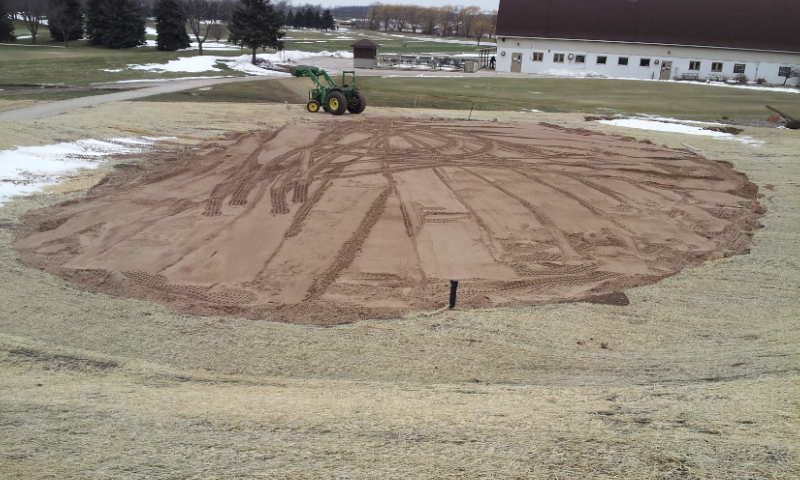
The mix is in and rough graded but the frozen chunks prohibited us from doing a final grade. By having the mix in now mother nature will help pack and settle it through freeze thaw processes and spring rains. In spring the green will be final graded and seeded and with any luck be open for practice sessions in late July.

 
Our final job will be to finish the sand bunker with a final grade, drainage and sand installation.
 
Enjoy your winter and remember the golf shop is open on Wednesday and Saturday from 8-2 for your golf conversation needs.

Thursday, November 22, 2012

Project Wrap-Up

It looks like the great stretch of weather will come to a end this week with highs forecasted to be in the 30's. Saturday the 24th will be the last day for play and we hope to apply a heavy application of sand to the greens next week.

We are glad many of you were able to enjoy the nice days November offered and take advantage of our free round for Veterans. Looking back I think November was nicer than October when considering the number of warm days.

The weather also allowed us to work on a couple projects to give us a head start next spring. The newly designed tee complex was dormant seeded and covered with straw to keep the seed in place until spring. A dormant seeding is when the seed is applied but not expected to germinate until next year. The benefit is the seed is down and ready to emerge long before we could work on the the wet ground next spring.

As a reminder we changed this tee complex for two main reasons. First the tee was unlevel and as a huge "runway tee" would be difficult to strip and level to customer expectations. Secondly this tee was left over from the old course before expansion to 27 holes so the tee lined up with a fairway that no longer exists. The tee encouraged players to hit the ball onto the 9th fairway more than the 10th.

The new 10th tee complex shifted the tees right and lined them up with the fairway. The silver and white tees are a bit shorter while the blue and black are the same length.
The chipping green project is also moving along well with the weather and hard work by the staff. The new addition should open mid to late summer next year with a sand bunker and many areas to practice your short game from. The area had to be elevated due to construction debris being buried under the site and mounding was added for aesthetics and safety.

The dirt for the mounding came from the nearby 10th tee project along with thousands of yards donated by Baumhardt Sand and Gravel as they were working down the street and it saved them money to give us the material rather than haul it away.
Trenching drain lines in the chipping green. 1" of pea gravel goes in the bottom followed by the perforated tile and then the trench is filled with pea gravel. (sometimes pictures from my phone will not stay upright so you need to tilt your head.)


Carefully spreading a 3" layer of washed pea stone on the green base while not driving on or catching the soil below.
Building a green takes a lot of steps, first the base is graded to the specified slopes, leaving a 12" lip of soil around the green. At this point the green looks like a pond or swimming pool and really confused some of the customers. Irrigation is put in around the green and drainage tile is put at the bottom of the green.

The lip of the green disappears when 3" of pea stone is laid on the base followed by 9" of sand/peatmoss mix called greensmix. In our case the greensmix will be installed in winter to allow the surrounds to freeze to reduce damage from the trucks.

But the best part of the warm November days is we were able to grade and seed the mounding around the green and then covered it with straw blanket to prevent erosion. This site was just under a acre and the small staff earned it's wages working hard to get it all done in one day.

In spring the greensmix will be graded and seeded and the bunker will be finished and filled with sand.

The new chipping green site with the surrounds covered with seed and straw. The sand bunker is
barely visible on the bottom left.
The final project for this fall is a redo of the red and silver tee on hole 17. The old tee was small and unlevel but also had large tree roots from the nearby pines poking out causing a unsafe condition. The new tee has been shaped and topsoil added. We will allow it to settle over winter and seed it in the spring.

To all our customers thank you for your business and feedback and enjoy your winter.

Sunday, October 14, 2012

Project Time

Each fall we try to finish one big project based on customer comments, feedback and what is good for the golf course. I can tell you now next year will be a redo of 27 green. We plan to strip the sod off the back half and lower the huge mound to create more cupping area and with luck and good weather put the sod back. We will also add some smaller mounds and new trees to separate the green from the clubhouse and driveway. The redo of 27 was not done this year because the WSGA (Wisconsin State Golf Association) asked us not to due to the State Best Ball being played at Rolling Meadows next spring.

But this year we started with a goal to build a chipping green near the putting green to give customers a great option for practicing their short game. The area needed to be raised and have some mounds around it so we secured a large amount of free fill for the project from a building addition down the road. Unfortunately the free clay fill turned out to be mainly concrete and blacktop so we had to turn it down.

The chipping green site right of the putting green.
Our second option for the needed material was to re-construct the nearby 10th tee as per the master plan drawn in 1993 but not done during the expansion to 27 holes. The project takes the old "runway" type tee and separates it into 4 tees while moving it right to line up with the fairway. The original tee was leftover from the old course and was set up to cause golfers to hit into the 9th fairway because the original first hole played up the current 9th hole and ended near the current 2nd fairway. We choose the 10th tee because it was close, had the extra material we needed, was un-level and one of four tees not redone during the expansion to 27 holes or since then. (5, 19, 24, 25 are the others)

The new tees line up with the hole the way it was designed.
 The 10th tee project will give us enough material to start the chipping green project but will probably not have enough for the mounding. We did hire a bulldozer to shape the tees and green but the rest of the work is done in house.

The staff removing excess soil from 10 tee to take to the chipping green.
The building of a quality chipping green will require a lot of in-house work. First the base of the green is built to match the final grade which in this case the green will have 2' of slope from back to front. Then a 7" lip of clay/soil mix will be built around the green followed by 3" of topsoil. The green will then look like a 10" pond. Drainage will be installed in the green and through the sand bunker. Then irrigation will be installed on the outside of the green. The 10" "pond" or green-site will be filled with a 2" layer of clear pea stone and a 8" layer sand/peatmoss mix.

It is our goal to get the tee and tee surrounds and green surrounds built and dormant-seeded this fall and covered with straw blanket and seed the green in the spring. All of this is weather dependent of course. Under normal conditions the areas should be open in mid summer.

We also hope to construct a new red/silver tee on hole 17 to replace the current tee that is too small and is having problems with root encroachment under the tee causing a dangerous situation if the tee markers are placed in the wrong place.

This weekends rain will slow the project down a couple days but was very needed to settle the tees and green-site along with filling the ponds and marshes. This was the first time in 16 years the marsh on holes 13/14 were empty so we could mow them.

Feel free to contact us with any suggestions you have for future projects we can consider. Items on our list of possible projects include.
  • Drain hole 9 pond and bring the bank back to the original design.
  • Level the back of 27 green. (Scheduled for 2013)
  • Re-build 19 tee to master plan.
  • Ease the approach to 25 green or enlarge 25 green.
  • Re-build 7 fairway to allow for easier second shots over the marsh.

Saturday, September 15, 2012

What happened to my lawn?

If you lawn is like mine it may be looking thin, weedy and full of crab and quack grass!  With a few steps you should be able to bring the turf around to have a healthy weedfree lawn for next summer.

Thin or bare areas - When the rain started after the drought most areas that are going to fill in with desirable grasses have by now or they are not going to. However depending on here you live and how much rain you had it is probable those areas died rather than just going dormant. Right now we are in a mini-drought with un-irrigated areas going dormant again but it looks as though rain is on the way.

The next couple weeks would be a great time to rake those areas with a steel rake and spread some seed. If possible lightly rake back and forth to work the seed into and past the dead material, pack down or cover with a light layer of soil as a topdressing and then pack. If it is only a couple patches covering with burlap or straw until the grass is up will help hold the moisture in to allow faster seed germination.

Even weedy areas can be seeded now and the weeds can be taken care of later in fall.

The best sunny lawn mix will have 80% kentucky bluegrass and 20% perennial ryegrass in it or up to 20% fine fescue. 100% kentucky bluegrass will work but it does take longer to germinate and emerge so the perenial rye is used as a nurse crop to help stabilize the soil and provide shade for the new bluegrass plants. For shady areas your mix should have more than 50% fine fescue in it with kentucky bluegrass and not more than 15% ryegrass. (Examples of fine fescue are creeping red, chewings and hard fescue.)

Beware of discount seed mixes that contain some or all annual ryegrass or rough bluegrass. Annual ryegrass will die over winter and rough bluegrass is not a desirable lawn mix. A perfect mix for the average lawn would be 60% kentucky blue, 30% fine fescue and 20% perennial ryegrass. This will allow the bluegrass to thrive in most of the lawn but the fescues to thrive in those few shady sites.

Weeds - During the drought weeds of all sorts took advantage of the dormant thin turf and are trying to take over. To control dandelion, clover, creeping charlie, creeping jenny, nut sedge and other perennial weeds wait until after a frost or two when the plants are weaker for better control. Even then creeping charlie may have to re-treated next spring when it starts growing again. A quality three way selective-herbicide from a reputable source will take care of the weeds. Spraying weeds is more effective than using a granular product but both should work when  used according to the label and directions.

Crabgrass usually comes up in late June and early July and looks light green in color and grows laterally or nearly flat on the ground. Right now it is seeding out with spiny looking stems and seed heads. Because it is a annual it will die during the first hard frost but the seeds it produces will be there next spring waiting to germinate. The best way to treat crabgrass at this point is to remember where it came up and treat those areas with a pre-emergent weed control next spring following the directions and rates on the label.

Quackgrass is a perennial and never goes away and can only be eliminated by using a non-selective-herbicide like roundup and killing everything and starting over. Quackgrass like many weeds is a plant of opportunity filling in thin areas of your lawn. The best treatment is to have a healthy bluegrass lawn to crowd out the quack. In years of normal rain it should be a minimal problem for quality lawns. The plants there today will live for years but a pre-emergent herbicide next spring should keep more plants from establishing from seed.

Fertilizer - September is a great time to fertilize your lawn while it is actively growing to prepare it for winter and next summer. Recent research has shown that a late fall fertilization is not as effective as once thought because it is not taken up by the plant. The amount and type of fertilizer needed really depends on your unique lawn so visit a vendor you trust and ask for a recommendation.

Fertilizer is sold as a 10-10-10 or 18-5-9 etc. The most important number is the first one or the amount of Nitrogen or "N". In a 18-5-9 fertilizer there would be 18lbs of nitrogen in 100lbs of product not the bag you purchase. Nitrogen comes in two forms: WIN or water insoluble nitrogen and WSN water soluble fertilizer. Water soluble fertilizer is normally considered quick release and will only last 3 to 4 weeks. WSN should make up 20 to 50% of the total nitrogen

The second number is for phosphorus or "P" and in most cases will be 0 due to state regulations and the fact most Wisconsin soils have enough phosphorus in them. For the golf course we take soil tests to check the amount of phosphorus and by law that is the only way we can apply it.

The third number is for potassium or "K" and is very important for plant health during stressfull times. In established lawns not much is needed but only a soil test can tell for sure.

Irrigation - Healthy lawns normally can thrive on just rain but in a year like this some supplemental irrigation may be needed for recovery or in future years to keep grass alive during long droughts. For established lawns and trees it is best to water heavy once a week to ten days rather than light every couple days. For this fall unless we get a above average amount of rain it would be a great time to water your established trees deeply. Let a slow running hose soak the area or use a soaker hose for a couple hours per tree to allow the water to penetrate deeply.

A healthy lawn brightens a homes landscape and increases home value. Yours may have taken a beating this summer but with a little time and work can be looking great by next spring.